
Once you’ve created an Exam (Graded) or Self (Non-graded) assessment or Forms, you can customize their settings to fit your needs. Assessments come with a range of important options that can significantly impact both the user experience and the outcome. Below is a detailed list of the available settings, how to enable them, and what each one does.
To locate the Assessment settings:
1. Navigate to the course you want to edit and go to the Course outline tab.
2. Hover over the assessment learning activity and click on Edit Questions.
3. In the Assessment Builder environment, click on Settings.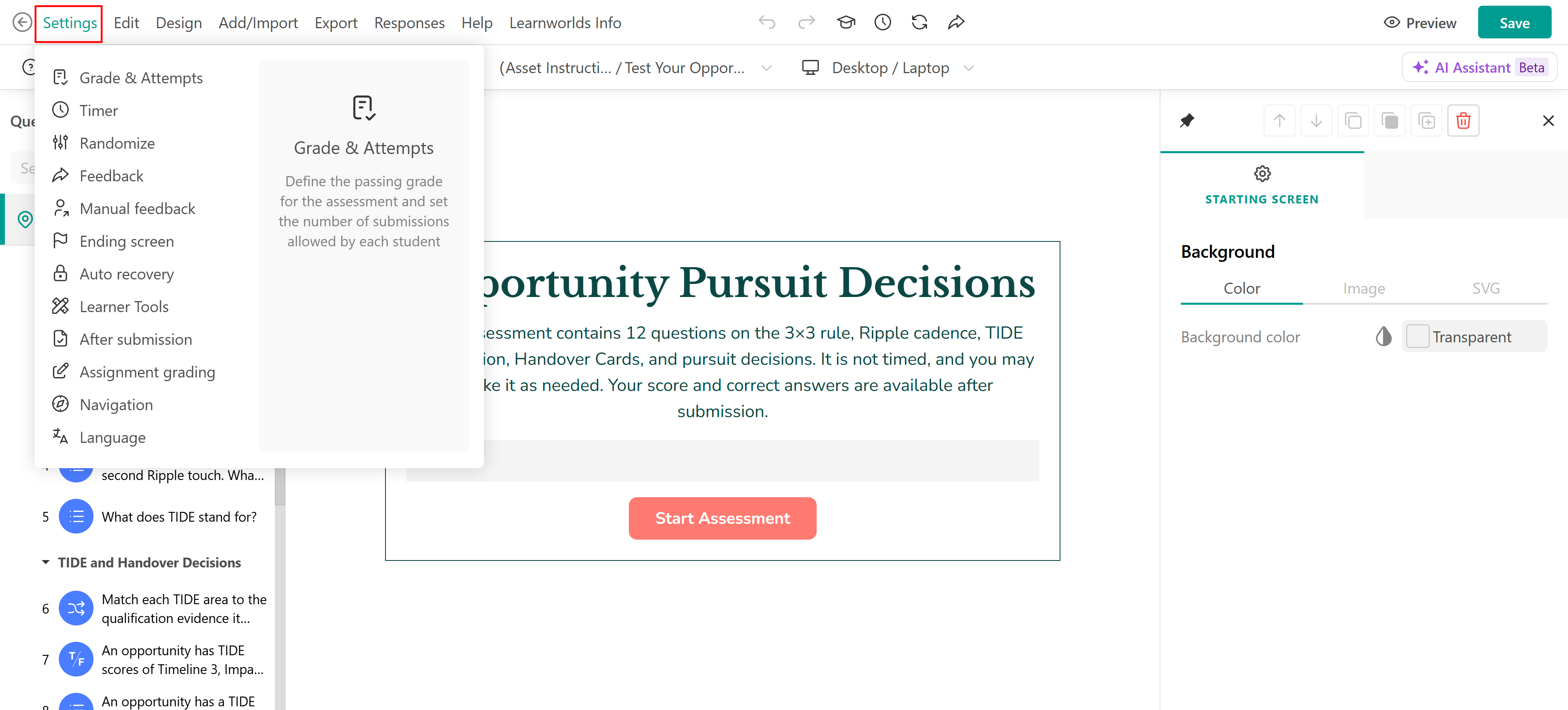
Let's analyze each setting for Exam/Self Assessments and Forms:
Exam/Self assessments
Grade & attempts
This section lets you set passing requirements and control how many times learners can attempt the assessment. You can also set up the confirmation popup, that prevents learners from accidentally submitting their assessment by requiring confirmation before submission.
- Grading & scores are not relevant in self-assessments. However, exam questions are still available and correctness and feedback are relevant.
- The confirmation popup appears right after the user clicks on the Submit button at the end of the exam, or answers the final question of the assessment when the Autonavigate setting is enabled in the card-based navigation mode under Design → Navigation.
Timer
Set a countdown timer for the assessment.
Randomize
Deliver all or a random subset of the questions to each student. Choose whether to shuffle the questions’ order. Randomization prevents cheating by ensuring that learners receive different question orders or sets.
- To allow randomization, ensure the Required setting under General, is disabled.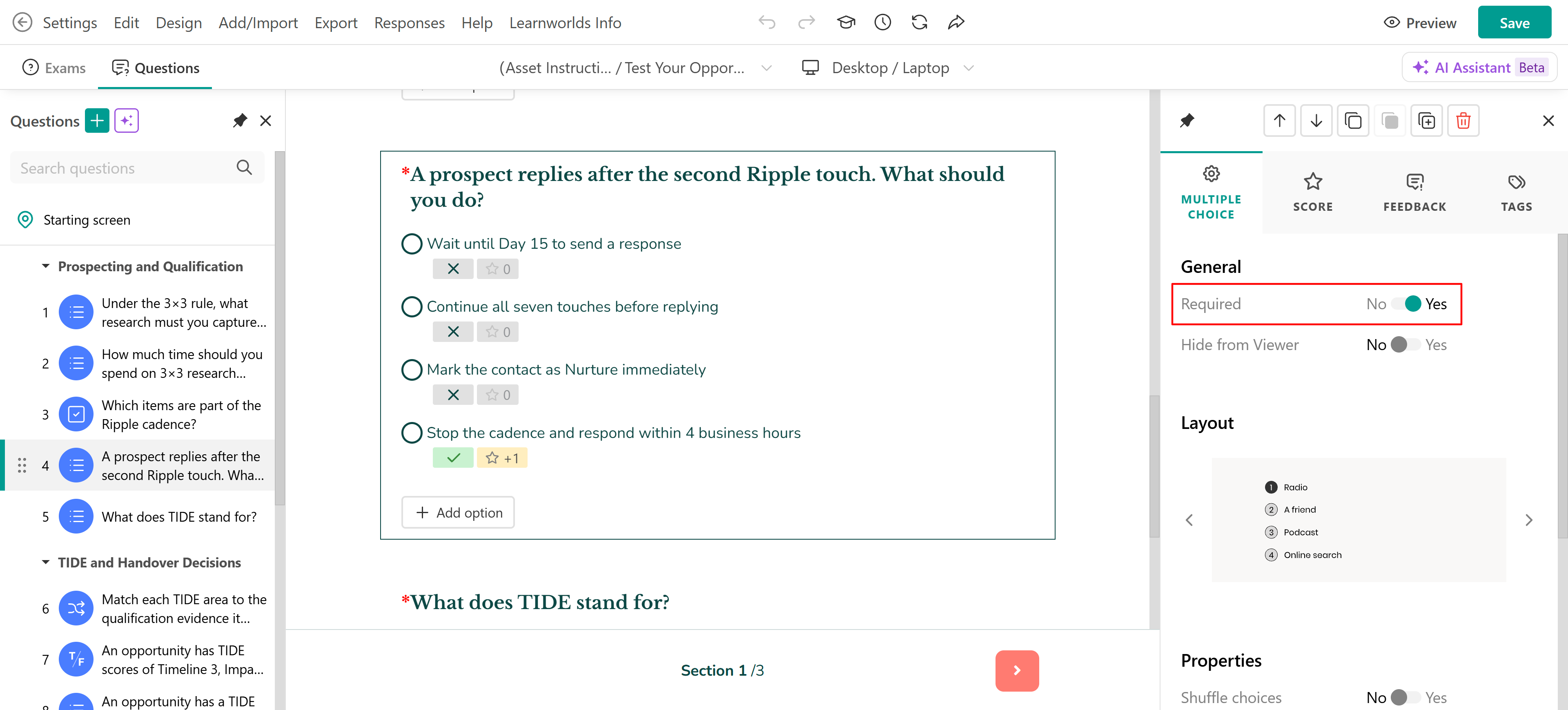
Feedback
Choose whether to offer a feedback report to the student and tweak the information included. Feedback reports help learners understand their performance by displaying results and explanations.
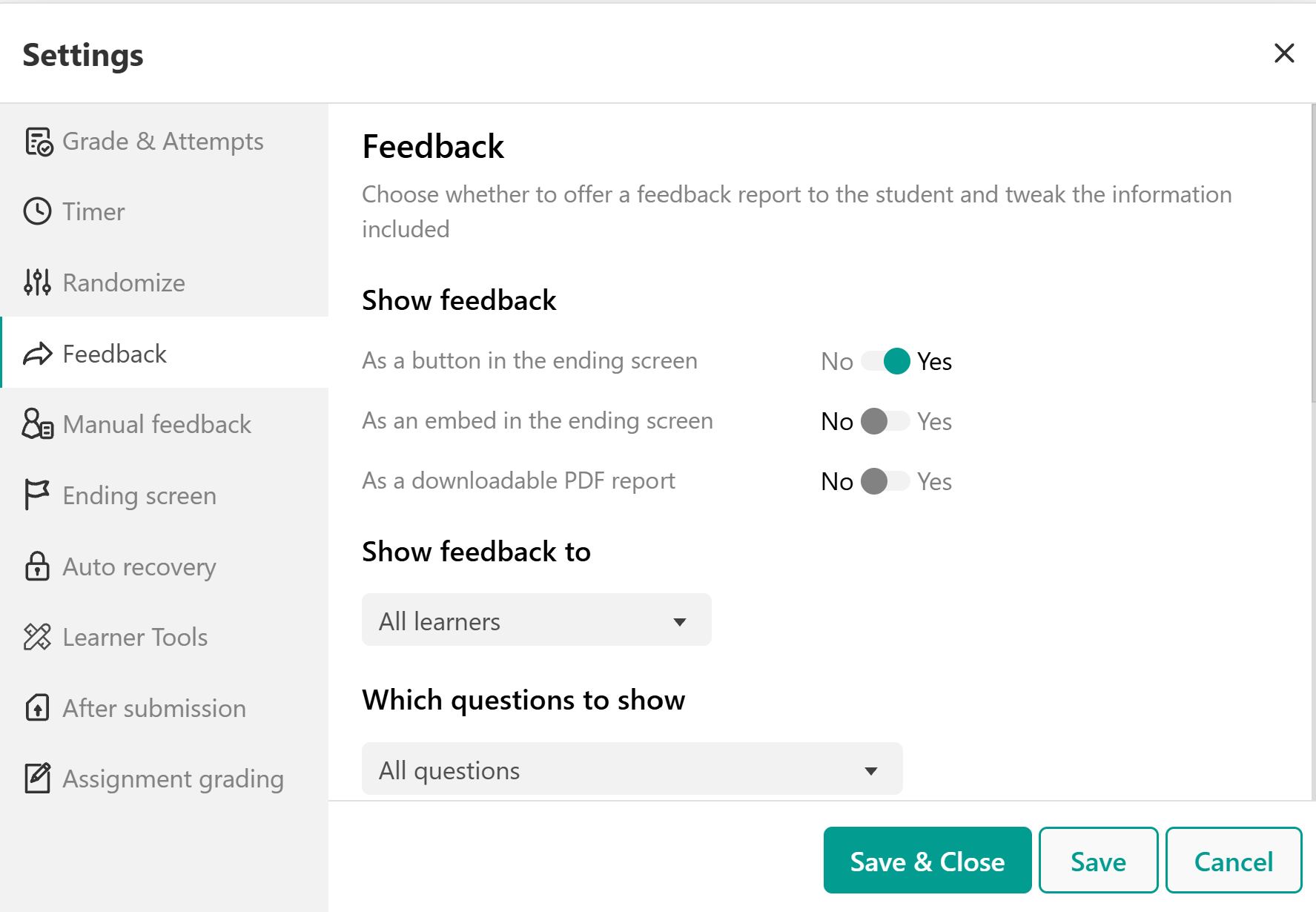
To add feedback to your questions, you need to:
1. Click on Edit questions on the question you wish to offer feedback.
2. Enable the setting Provide feedback.
You can also enable Advanced feedback, in which you can add different feedback for each option.
Manual feedback
If manual feedback is enabled, assessments with closed-ended questions will be reviewed via the Review Center. Students will see a Pending Feedback message and receive a notification once feedback is posted.
- Assessments containing assignment-type questions (open-ended, text, file submission) are always sent to the Review Center, requiring manual grading.
Ending screen
In the Ending screen settings, you can configure the widgets presented in the ending screen (e.g., results in analysis widget).
Auto recovery
By activating this setting, you can allow your students to navigate away and return to the assessment within a time window without losing their answers.
- For Exams, the Admin/Instructor can choose when a user comes back after the auto recovery period passes, whether they fail or not. If this option is not activated, the users do not fail the answers are deleted, and they must re-attempt it.
- For Self-assessments, the user does not fail when they don’t come back within the auto recovery period, the answers are deleted, and they must re-attempt it.


- You may encounter Abandoned, Unfinished, or Rejected statuses. The Abandoned status happens when a user fails the exam and does not come back within the auto-recovery period. If a user leaves mid-assessment without interruptions enabled, when they visit the assessment again they will see the ending screen with the attempt graded as 0.
- The Unfinished status is shown if a user leaves the submission, doesn't come back before the auto-recovery time runs out, and hasn't revisited the assessment yet. Unfinished logs are not included in the export report file.
- The Rejected status can happen for submissions that are invalid due to browser session expiration. For example, if a required question has not been answered or the timer expired and the submission took place.
- The auto-recovery option is not available in preview mode; it only functions when the course is accessed as a student.
Learner tools
Show a sidebar presenting all available questions concisely. Allow students to navigate easily between questions and bookmark them.
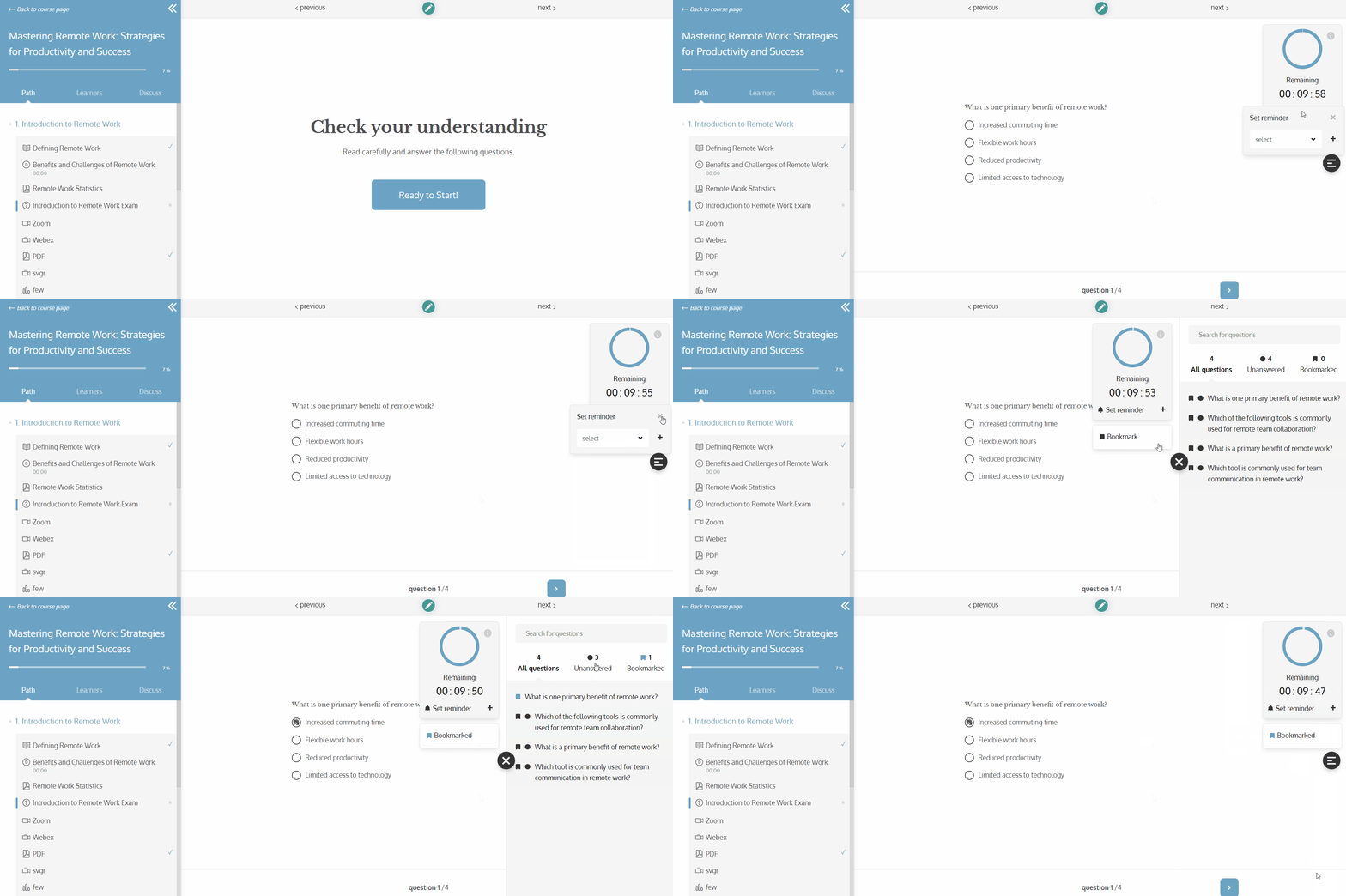 Only users can set reminders (the admin cannot pre-set the reminders for the users), bookmark questions, and search among question descriptions.
After Submission
You can tag students after assessment submission. For exams (graded assessments) you can also tag users who pass the assessments.

Assignment grading (Graded Assessment only)
Set the passing grade for assignment questions in exams (open-ended questions). Inherit the assessment’s passing grade or set a different one for the assignments.
Select when the assignment is considered correct:
- Based on the assessment's passing grade
- Set a passing grade for all assignment questions
Navigation
This section allows you to configure how learners navigate between questions. Learn more about the available options here.

Language
You can find and customize system UI texts.

Forms
- The Certificate of Knowledge settings are identical to the Exam settings, with one additional option: Certificate Sharing. This setting allows you to enable social share buttons on the assessment’s completion screen, making it easy for students to share their certificate on social media platforms such as LinkedIn, X (formerly Twitter), and Facebook.